

Musculoskeletal · SBA · Tutor mode
Ahmad, a 45-year-old Malay man, attends your Klinik Kesihatan for a scheduled chronic disease review. He has type 2 diabetes mellitus, hypertension, chronic gouty arthritis, chronic kidney disease stage 3b and dyslipidaemia, and is co-managed at Hospital Putrajaya. His medicines are metformin 500 mg orally twice daily, empagliflozin 10 mg orally once daily, losartan 100 mg orally once daily, amlodipine 5 mg orally once daily, atorvastatin 40 mg orally at night and allopurinol 300 mg orally once daily; he reports good adherence. He asks about a swelling over his right outer ankle, present continuously for about a year with little change in size. It is painless, with no recent flare, redness, warmth, sudden worsening, fever, trauma or discharge, and no calf pain, contralateral leg swelling, orthopnoea or worsening exertional breathlessness. The swelling now rubs against his footwear, he can no longer wear his usual covered work shoes, and his ankle feels restricted on prolonged walking. He asks how the swelling itself can be resolved rather than only preventing further attacks.
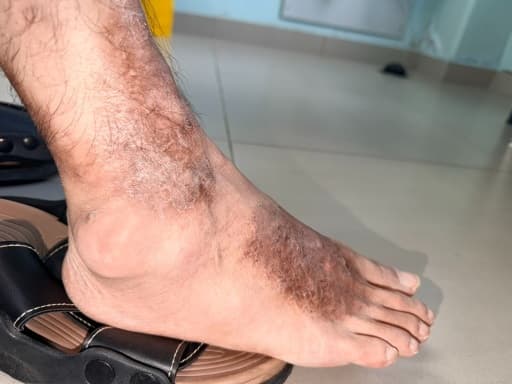
He is alert and pink, with blood pressure 145/90 mmHg, pulse 96 beats/min and temperature 36.2°C. Over the right lateral malleolus there is a firm, lobulated, non-fluctuant swelling of approximately 4 cm, minimally mobile and fixed to deeper periarticular tissue, non-tender and not warm, with no acute erythema and intact but stretched overlying skin; ankle movement is mildly restricted. Dorsalis pedis and posterior tibial pulses are palpable, capillary refill is normal, protective sensation is intact, and there is no plantar ulcer or spreading cellulitis. Serum urate is 282 µmol/L (reference range 210-420 µmol/L), having remained below 300 µmol/L on repeated testing over the preceding 12 months; estimated glomerular filtration rate is 38 mL/min/1.73 m² and HbA1c is 7.4%.
What is the BEST management for his concern?
- AIncrease allopurinol to 400 mg once daily
- BChange to febuxostat 40 mg once daily
- CIncrease amlodipine to 10 mg once daily
- DRefer to orthopaedics for tophus excision
- EContinue urate optimisation and observe
Correct — Explanation
Stem context
Ahmad has long-standing chronic gouty arthritis with a firm, lobulated, non-tender periarticular mass over the right lateral malleolus that has been static for about a year. The absence of erythema, warmth, tenderness, fever, discharge and any recent flare excludes an acute crystal flare, septic arthritis and soft tissue infection. There is no calf pain or contralateral leg swelling to suggest venous thromboembolism, and no orthopnoea, exertional dyspnoea or pitting oedema to suggest a fluid-overload cause. His diabetic foot assessment is reassuring: palpable pulses, normal capillary refill, intact protective sensation and no ulceration. Serum urate has been sustained below 300 µmol/L on repeated testing on a stable, well-tolerated dose of allopurinol with good adherence. What has not resolved is the mechanical consequence: the mass rubs on covered footwear, he cannot wear his work shoes, and ankle movement is restricted on prolonged walking. Chronic kidney disease stage 3b and diabetes are relevant to perioperative planning and wound healing, not to whether referral is warranted. Blood pressure of 145/90 mmHg is above target and needs separate attention.
Question rationale
This item tests whether the candidate can separate systemic urate control from the management of an established, mechanically limiting deposit. Four competing strategies are offered: escalating the current urate-lowering therapy, switching urate-lowering agent, treating a coexisting but unrelated problem, and continuing medical treatment with observation.
A serum urate of 282 µmol/L sits within the laboratory reference range, but the reference range is not the treatment goal. In gout, the treat-to-target threshold is a serum urate below 360 µmol/L, and a lower target below 300 µmol/L is applied in severe or tophaceous disease to accelerate deposit dissolution. Ahmad is already at the lower, more demanding target, and has been for approximately a year. Further pharmacological intensification therefore has no clear urate rationale and, more importantly, cannot promptly restore footwear tolerance or ankle movement.
The main AKT trap is this: a serum urate result at target does not mean an established functionally limiting tophus requires observation alone. Candidates who anchor on "urate is controlled, so continue and observe" miss that the presenting complaint is mechanical, not metabolic, and that sustained adequate medical therapy has already been given a fair trial without resolving it.
Answer explanation
Referral for orthopaedic assessment is the best management of the concern Ahmad actually raises. He has a persistent, firm, fixed periarticular mass that has not regressed despite approximately 12 months of sustained serum urate below the severe-gout target, and it is now causing demonstrable functional impairment: he cannot wear covered work shoes, and ankle movement is limited on prolonged walking. Deposits that impair joint movement, prevent normal footwear, ulcerate, become infected or compress nerves are the group in which surgical opinion is appropriate; asymptomatic or cosmetic deposits are not.
Referral is for specialist assessment, not for excision performed in primary care, and it does not guarantee an operation. The orthopaedic team can confirm the anatomy and extent of the deposit, assess for underlying joint destruction, tendon involvement, ulceration, infection or neuropathy, consider imaging where needed, and judge whether debulking would produce a worthwhile functional gain. Surgery for gouty deposits is generally reserved for selected complicated or functionally limiting cases after adequate medical treatment, because wound breakdown, sinus formation, infection and tendon or neurovascular injury are recognised risks. Ahmad's diabetes and chronic kidney disease stage 3b raise those wound-healing and perioperative risks specifically, which is a reason for careful specialist planning and shared decision-making about benefit, recurrence and complications rather than a reason to withhold referral.
Urate-lowering therapy must continue unchanged before and after referral unless a contraindication emerges, with serum urate maintained below 300 µmol/L, since ongoing urate control limits recurrence at the operated site and progression elsewhere. Monitor renal function and adherence at routine reviews. Separately, and at the same visit, review his blood pressure of 145/90 mmHg against his target given diabetes and chronic kidney disease, and address glycaemic control with an HbA1c of 7.4% as part of the chronic disease review. Safety-net by advising him to return promptly if the swelling becomes red, hot, painful, discharges, ulcerates or enlarges rapidly, or if he develops fever.
Why the other answer options are not acceptable
Increase allopurinol to 400 mg once daily: Allopurinol can legitimately be titrated above 300 mg daily in selected patients, including carefully monitored patients with reduced renal function, so this is not categorically prohibited here. It is not best because Ahmad is adherent, tolerating the drug, and his serum urate has been sustained below 300 µmol/L for about a year — he is already on a maximally tolerated and clinically effective dose with no urate gap to close. Escalation would be reasonable in a patient whose serum urate remains above target, or who continues to have flares or expanding deposits despite adherence, but it will not restore footwear tolerance or ankle movement in this patient.
Change to febuxostat 40 mg once daily: Febuxostat is a genuine alternative xanthine oxidase inhibitor and is a reasonable choice when allopurinol is contraindicated, not tolerated, or fails to achieve target despite adequate titration. None of those apply: Ahmad tolerates allopurinol, has no features of hypersensitivity, and is already at the severe-gout target. Switching agents in a patient at target offers no additional benefit, exposes him to a new drug and its cardiovascular safety considerations, and does not address the established mechanical obstruction. Febuxostat should not be presented as automatically superior simply because chronic kidney disease is present.
Increase amlodipine to 10 mg once daily: His blood pressure of 145/90 mmHg is above target for a patient with diabetes and chronic kidney disease, so antihypertensive review is genuinely required and should not be ignored — but it is a separate problem from the question asked. The ankle swelling is a firm, lobulated, fixed, unilateral periarticular mass with no pitting oedema, not dependent oedema, so it will not respond to blood-pressure treatment. Dose escalation would be the right move if the swelling were bilateral dependent oedema with uncontrolled hypertension driving the consultation; here, note also that amlodipine itself can cause peripheral oedema, although that is not the mechanism in this case. Address his blood pressure at this visit as a distinct issue.
Continue urate optimisation and observe: This is appropriate for uncomplicated deposits that are painless, not interfering with function and expected to shrink gradually with sustained urate lowering, and urate-lowering therapy must indeed continue regardless of what else is done. It is not the best answer because Ahmad has already had approximately 12 months of adequate urate control at the lower severe-gout target without regression, and the deposit is now preventing comfortable use of covered footwear and restricting ankle movement. Continuing to watch defers a functional problem that has already failed a fair trial of medical management.
Learning points
- Treat-to-target urate-lowering therapy should continue in chronic tophaceous gout, aiming for serum urate below 360 µmol/L generally and below 300 µmol/L in severe or tophaceous disease; a result inside the laboratory reference range is not the same as being at target.
- Allopurinol should be started at a lower dose in chronic kidney disease and titrated according to tolerance, renal function and serum urate response rather than to an assumed fixed renal ceiling.
- Febuxostat is generally considered when allopurinol is contraindicated, not tolerated or ineffective, not as a routine substitute in a patient already at target.
- Uncomplicated deposits often shrink gradually with sustained urate control, so observation with continued urate-lowering therapy is reasonable when function is preserved.
- Deposits that restrict joint movement, prevent normal footwear or otherwise limit daily function warrant specialist surgical assessment after adequate medical therapy; referral allows planning and shared decision-making and does not commit the patient to surgery.
- Infection, ulceration, rapid enlargement or neurovascular compromise indicate greater urgency, and diabetes and chronic kidney disease raise wound-healing and perioperative risk that must be factored into any surgical decision.
References
- Management of Gout, Second Edition (Clinical Practice Guidelines) - Ministry of Health Malaysia, Malaysian Society of Rheumatology and Academy of Medicine Malaysia, 2021
- Gout: diagnosis and management (NG219) - Evidence review for surgical excision of tophi, National Institute for Health and Care Excellence, 2022
- Murtagh's General Practice, 5th Edition - John Murtagh and Jill Rosenblatt, McGraw-Hill Australia, 2011